| |
| 12 April 2024 last updated |
 |
| Latest Gilt Yields Chart |
|
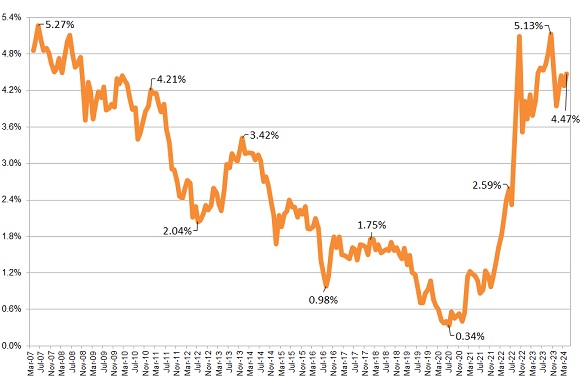
| 15-year gilt yields - last 17 years |
| Based on figures for April 2024 |
 |
| |
15-year gilt yields chart is at 4.47% on 12 April 2024
Find out more details:
Monthly analysis of annuities and gilt yields
Annuity rates are based primarily on the 15-year gilt yields so changes in gilt yields will affect annuities. The above chart shows yields at an all time low of 0.162% on 9 March 2020 after concerns over a no-deal Brexit, the US-China trade tensions and fear of recession due to the Coronavirus.
The 15-year gilt yields had reduced significantly since June 2008 due to the financial crisis and reached a record high of 5.13% on 23 October 2023 as interest rates are expected to be higher for longer. |
|
|
|
As a general rule a 30 basis point rise in yields would increase annuities by 3.0% although the providers may take time to introduce these changes depending on their own strategies.
By 1 April 2024 yields were -55 basis points lower than the figures in July 2008 when they were 4.83%.
The 15-year gilt yields decreased by -17 basis points to 4.28% during March 2024 with providers of standard annuities decreasing rates by an average -3.38% for this month and rates may increase by +1.68% in the short term if yields remain at current levels.
For smoker and enhanced annuity providers have decreased their rates by an average of -1.56% and rates may decrease by -0.14% in the short term if yields remain at current levels.
For the latest updates see Annuity Rates Review. |
| |
 |
Annuity Rates Chart
Read the latest annuity rates review to find out if this is the best time to buy an annuity. |
| |
|
 |
Annuity Rates Changes
Find out about the latest changes in annuity rates and if they are rising or falling. |
|
 |
|
|
|
|
| Single |
 |
| |
55 |
£6,157 |
|
|
| |
60 |
£6,591 |
|
|
| |
65 |
£7,295 |
|
|
| |
70 |
£8,213 |
|
|
| Joint |
|
| |
55 |
£5,902 |
|
|
| |
60 |
£6,307 |
|
|
| |
65 |
£6,868 |
|
|
| |
70 |
£7,669 |
|
|
| £100,000 purchase, level and standard rates |
|
|
|
| Annuity Quotes |
| Ask for a free quote with up to 25% more income or 40% for impaired health. |
 |
Free quotes |
|
No obligation |
|
All providers |
|
 |
|
|
|
| Flex-Access Drawdown |
| • |
Take control of your money |
 |
| • |
Easy access |
 |
| • |
Tax free cash |
|
| • |
Family benefits |
|
| • |
Keep your fund |
|
 |
|
|
|
|
| Follow the latest annuity updates on Twitter or Facebook |
|
| |
 |
 |
|
|
|
|